A Conditional Generative Adversarial Network (cGAN) is a type of Generative Adversarial Network (GAN) where the generation process is conditioned on some additional information, such as class labels or data from other modalities.
Architecture modification
Generator
Concatenate the conditional information Y with the noise input Z and feed it to the generator.
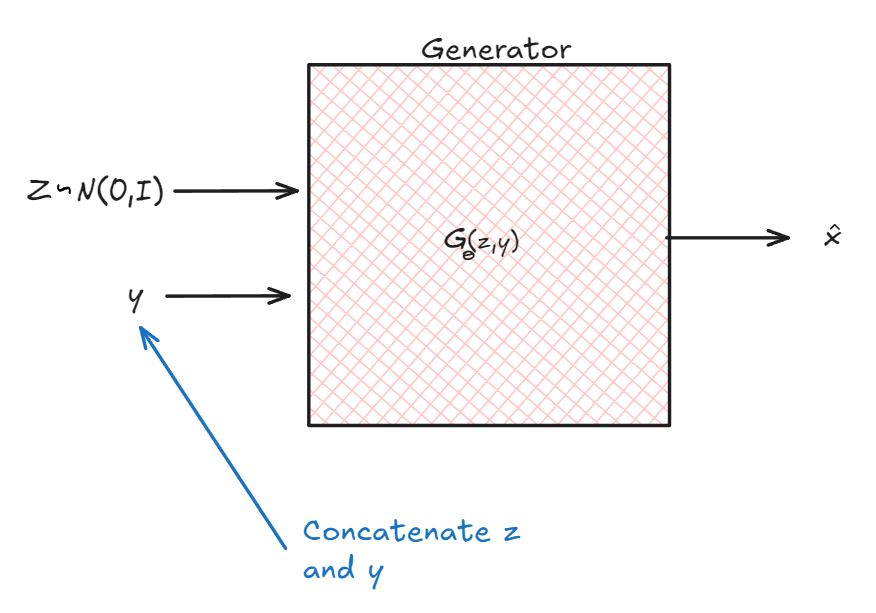
Here Y can be:
- One hot encoded class label
- Text embedding etc
Discriminator
The discriminator in a cGAN is modified similarly to the generator. Concatenate the conditional information Y with the input image X and feed this combined input (X, Y) to the discriminator.

This allows the discriminator to assess both the realism of the image and its correspondence to the given condition.
Objective of cGAN
The objective function of cGAN is an extension of the GAN objective, where both the generator and discriminator are conditioned on y:
Where:
- $G$ is the generator
- $D$ is the discriminator
- $x$ is the real data
- $z$ is the random noise input
- $y$ is the conditional information
- $p_{data}(x|y)$ is the conditional probability density function of the real data given $y$
- $p_z(z)$ is the probability density function of the noise distribution
This objective function encourages the generator to produce samples that not only look realistic but also correspond to the given condition $y$. The discriminator, in turn, learns to distinguish between real and fake samples while taking the condition into account.
Optimization process
The optimization process for cGANs involves alternating between training the discriminator and the generator:
Discriminator Optimization
The discriminator aims to maximize the probability of correctly classifying real and generated samples, conditioned on $y$:
Generator Optimization
The generator tries to minimize the discriminator’s ability to differentiate between real and fake samples by minimizing:
$$ L_G = -\mathbb{E}_{z \sim p_z(z)}[\log(1 - D(G(z|y)|y))] $$
This is the standard form of the generator’s loss in cGANs, derived from the minimax objective. However, in practice, to avoid vanishing gradients early in training, it’s often implemented as:
During training, these two steps are alternated, with the discriminator and generator parameters updated using gradient descent (or a variant) to minimize their respective loss functions.