Idea
Joint Embedding Predictive Architecture (JEPA) combines predictive learning with representation learning in a unified framework.
Formulation
Let us formalize the JEPA framework:
Given:
- Input space $\mathcal{X}$
- Context patch $x_c \in \mathcal{X}$
- Target patch $x_t \in \mathcal{X}$
- Context encoder $f_\theta: \mathcal{X} \rightarrow \mathcal{Z}$
- Target encoder $g_\phi: \mathcal{X} \rightarrow \mathcal{Z}$
- Predictor network $h_\psi: \mathcal{Z} \rightarrow \mathcal{Z}$
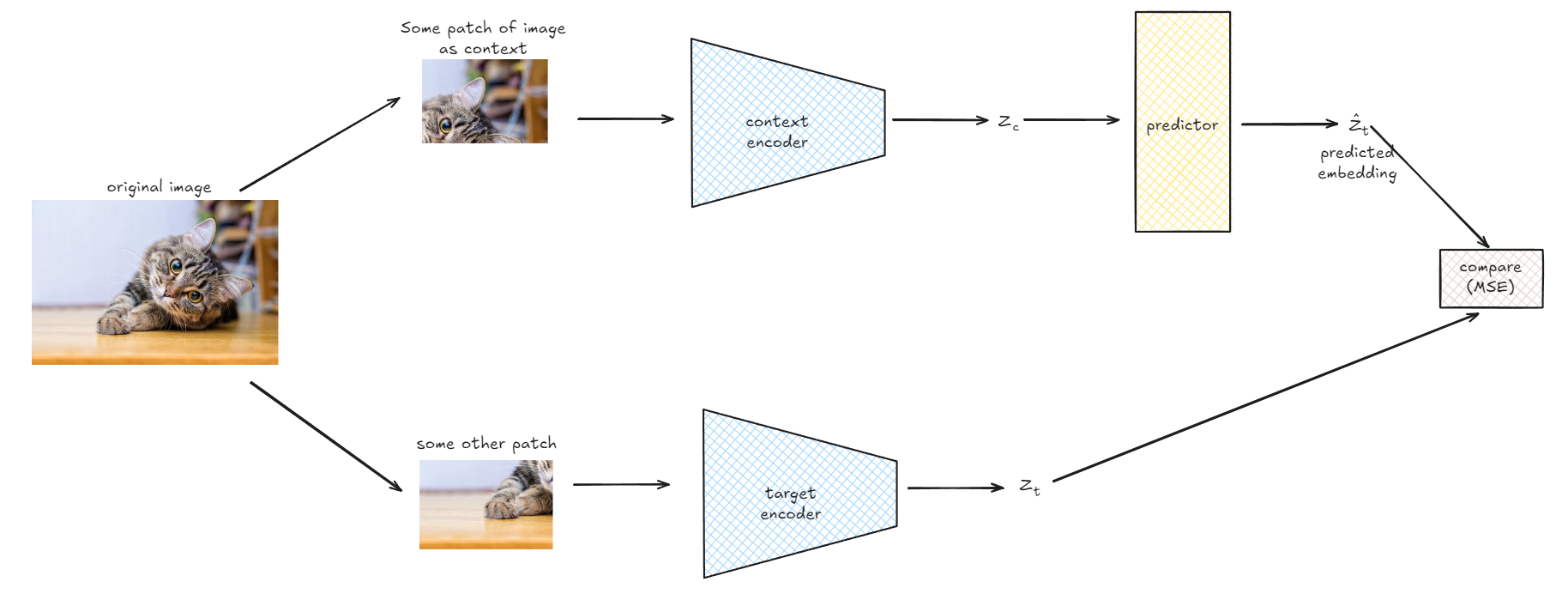
The process works as follows:
- Encode context: $z_c = f_\theta(x_c)$
- Encode target: $z_t = g_\phi(x_t)$
- Predict target embedding:
$\hat{z}_t = h_\psi(z_c)$The objective is to minimize prediction error in embedding space:
$$\mathcal{L}(\theta,\phi,\psi) = \mathbb{E}_{(x_c,x_t) \sim p_\text{data}}\left[\|z_t - \hat{z}_t\|^2\right]$$
where:
- The expectation is over pairs of context and target patches
- $|\cdot|$ denotes Euclidean distance
- Parameters $\theta,\phi,\psi$ are learned jointly
- Key properties:
- Learns representations by predicting embeddings rather than raw inputs
- Uses vision transformer architecture as underlying backbone
- Can leverage any encoder architecture for inference
- Enables both predictive and autoencoding objectives
This approach combines benefits of predictive learning and representation learning while avoiding pixel-level reconstruction.
Training and Downstream Usage
During training, three components are trained jointly:
- Context encoder $f_\theta$ that maps context patches to embeddings
- Target encoder $g_\phi$ that maps target patches to embeddings
- Predictor network $h_\psi$ that predicts target embeddings from context embeddings
The training process optimizes:
- Context encoder parameters $\theta$
- Target encoder parameters $\phi$
- Predictor network parameters $\psi$
Through minimizing the prediction error in embedding space.
For downstream tasks:
- The target encoder $g_\phi$ is typically used as the main feature extractor
- This is because the target encoder learns to create embeddings that:
- Capture meaningful semantic information about inputs
- Are predictable from context, implying they encode important features
- Don’t rely on predicting low-level details like pixels
- The context encoder can also be used but generally performs slightly worse since it’s optimized for prediction rather than representation
Common downstream applications include:
- Image classification: Use target encoder embeddings as input features
- Object detection: Use target encoder as backbone network
- Semantic segmentation: Use target encoder for dense feature extraction
- Other vision tasks that benefit from pre-trained representations