A Naive GAN (Generative Adversarial Network) refers to the basic or “vanilla” version of GANs, introduced by Ian Goodfellow in 2014.
Derivation
Recall the genereral expression for the GANs that we got by minimizing F-divergence:
where:
- $\theta$: Parameters of the generator network
- $\phi$: Parameters of the discriminator (critic) network
- $\theta^*$: Optimal parameters for the generator
- $\text{argmin}_\theta$: Argument that minimizes the expression with respect to $\theta$
- $\sup_\phi$: Supremum (least upper bound) with respect to $\phi$
- $T_\phi(x)$: The discriminator function, parameterized by $\phi$
- $f^*$: The convex conjugate of the function $f$ used in the F-divergence
- $p_{data}$: The true data distribution
- $p_{generator}$: The distribution of the generated data
Write $T_\phi(x)$ as composite function $T_\phi(x) = \sigma(V_\phi(x))$, where $\sigma$ is the sigmoid function Substitute this in the expression for GANs:
$$f(t) = t \log t - (t+1) \log(t+1)$$
The convex conjugate of this function is:
$$f^*(t) = -\log(1-e^t)$$
Substituting this into our expression:
Substitute $\sigma(V_\phi(x)) = \frac{1}{1+e^{-V_\phi(x)}}$, we get:
Simplify the expression using:
$$1 - \frac{1}{1+e^{-V_\phi(x)}} = \frac{e^{-V_\phi(x)}}{1+e^{-V_\phi(x)}}$$
This gives us:
Using the properties of logarithms and the fact that $\frac{e^{-V_\phi(x)}}{1+e^{-V_\phi(x)}} = 1 - \frac{1}{1+e^{-V_\phi(x)}}$, we can rewrite:
This is equivalent to:
This is the standard form of the GAN objective function as presented in the original paper by Goodfellow et al.
Interpretation
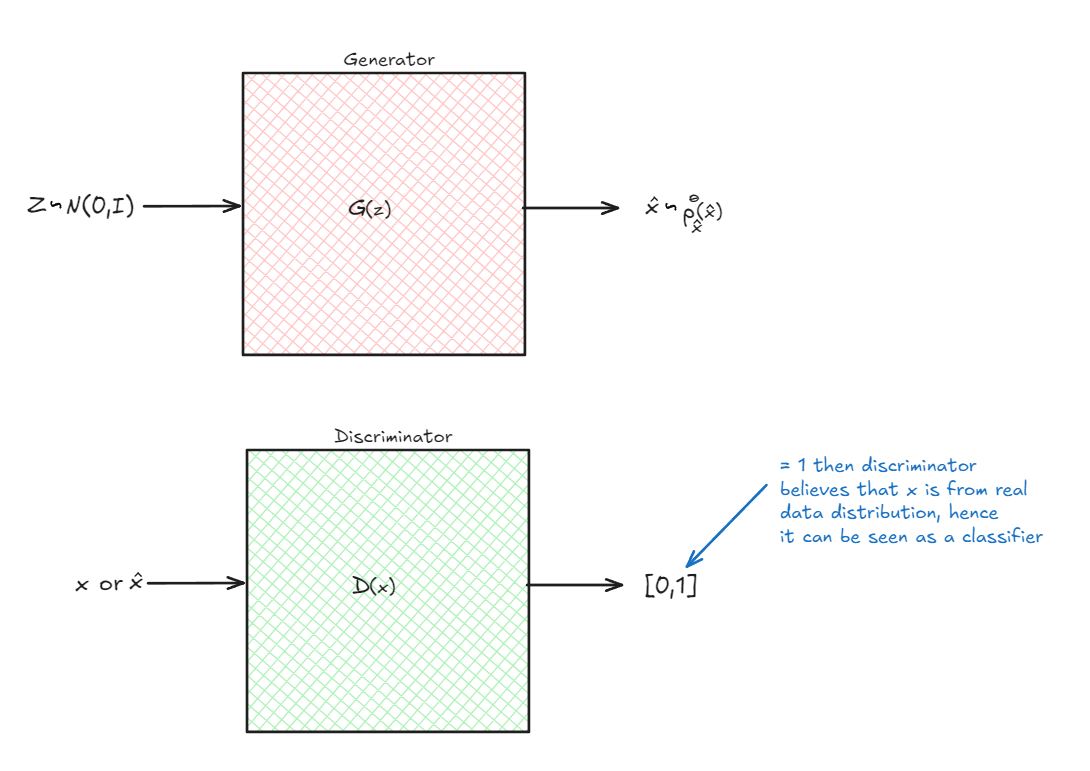
In the naive GAN framework, we can interpret the roles of the discriminator and generator as follows:
- Discriminator ($D$):
- The discriminator aims to maximize
- Because discriminator is of the form $D_\phi(x) = \frac{1}{1+e^{-V_\phi(x)}}$, it outputs a probability between 0 and 1, where:
- $D_\phi(x) \approx 1$ indicates the discriminator believes $x$ is from the real data distribution
- $D_\phi(x) \approx 0$ indicates the discriminator believes $x$ is from the generator (fake data)
- This pushes the discriminator to correctly classify real and fake samples.
Generator ($G$):
- The generator aims to minimize
The first term is the expected log-likelihood of the discriminator classifying a real sample as real, and the second term is the expected log-likelihood of the discriminator classifying a generated sample as fake. The first term is a constant with respect to the generator, so the generator aims to minimize the second term. Hence,generator tries minimise
- If the generator produces samples that the discriminator classifies as real, $D_\phi(x) \approx 1$. Then $\log(1-D_\phi(x)) \approx 0$.
Note that this kind of neat interpretation of the roles of the discriminator and generator is not possible for other choice of $f$ and $f^*$.
Training
The training process for GANs involves alternating between training the discriminator and the generator. Here’s a step-by-step explanation of the training process:
Initialize the Generator ($G$) and Discriminator ($D$) networks.
For each training iteration:
a. Train the Discriminator:
- Generate a batch of fake samples using the generator: $x_{fake} = G(z)$, where $z$ is random noise.
- Sample a batch of real data: $x_{real}$.
- Calculate the discriminator’s loss:
- Update the discriminator’s parameters using gradient descent to minimize $L_D$.
b. Train the Generator:
- Generate a new batch of fake samples: $x_{fake} = G(z)$
- Calculate the generator’s loss:
The training process continues until the generator produces samples that are indistinguishable from real data, or until a predetermined number of iterations is reached.