Perfect Discriminator theorem
The Perfect Discriminator theorem states that if two distributions $p_x$ and $q_x$ have support on two disjoint subsets $M$ and $P$ respectively, there always exists a discriminator $D^*: x \rightarrow [0,1]$ that has accuracy 1:
$$\forall x \in M \cup P, D^*(x) = \begin{cases} 1 & \text{if } x \in M \ 0 & \text{if } x \in P \end{cases}$$
This discriminator achieves perfect classification, as it correctly identifies the origin of every sample with 100% accuracy.
The Perfect Discriminator theorem has significant implications for GANs:
- It can lead to training instability and convergence issues, as the generator receives no useful gradient information when the discriminator achieves perfect accuracy.
- It may result in mode collapse, where the generator produces a limited set of samples rather than capturing the full diversity of the real data distribution.
- This theorem motivates the use of regularization techniques and alternative GAN formulations to ensure meaningful learning can occur.
Wasserstein GANs (WGANs)
Recall in the original formulation of GANs, we have:
$$\theta^* = \underset{\theta}{\argmin} , D_f(P_{data} \parallel P_{generator})$$
In Wasserstein GANs, we replace the F-divergence with the Wasserstein distance of order 1:
$$\theta^* = \underset{\theta}{\argmin} , W_1(P_{data} \parallel P_{generator})$$
$$\theta^* = \underset{\theta}{\argmin} , \inf_{\gamma \in \Gamma(P_{data},P_{generator})} \mathbb{E}_{(x,y) \sim \gamma} [d(x,y)]$$
use Kantorovich-Rubinstein duality to get (derivation skipped):
where $f$ is a 1-Lipschitz function.
What is k - Lipschitz?
K lipschitz is defined as: $$|f(x) - f(y)| \leq K |x-y|$$
Hence 1-Lipschitz is defined as: $$|f(x) - f(y)| \leq 1 |x-y|$$
How to enforce 1-Lipschitz constraint?
We use neural networks with parameter $\omega$ to model $f$, hence we can rewrite (1) as:
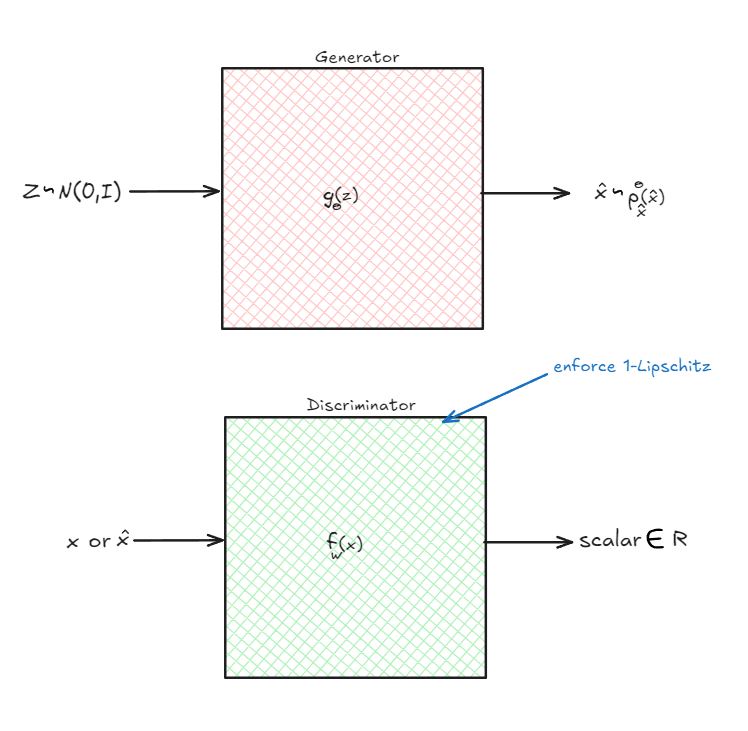
We enforce the 1-Lipschitz constraint on $f$ ie discriminator network by:
- Gradient clipping: $|| \nabla f || \leq 1$
- Weight normalization: $|| \omega || = 1$